Introduction
On May 24, 2025, Bitcoin stood as one of the most closely watched financial assets in the world. Investors, traders, and analysts alike paid attention to its every movement, especially in a year marked by strong institutional adoption, shifting government policies, and fluctuating macroeconomic conditions. This particular date offers valuable insight into the state of the cryptocurrency market mid-year, reflecting both global economic sentiment and the unique factors influencing digital assets.
In this article, we break down the exact Bitcoin price on May 24, 2025, analyze the key drivers behind it, and explore what this information could mean for future market trends.
Historical Bitcoin Price – May 24, 2025
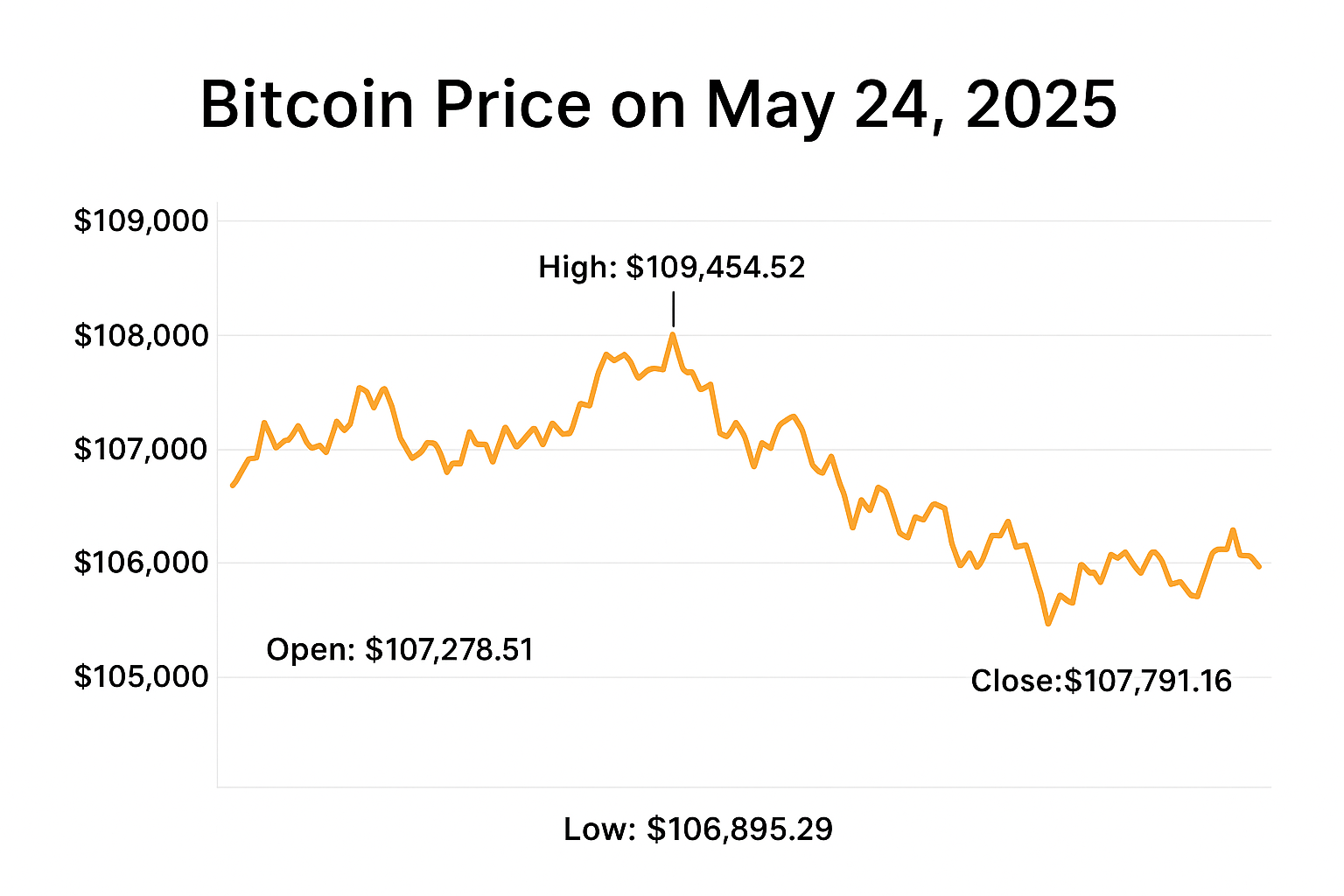
On May 24, 2025, Bitcoin opened the trading day at approximately $107,278, reached an intraday high near $109,454, dipped to a low of around $106,895, and closed the day near $107,791.
This movement shows a relatively narrow trading range, indicating a short-term consolidation phase. Despite the lack of extreme volatility that day, the price action remained significant due to its positioning after a strong bullish run earlier in the month.
Key figures for the day:
Opening Price: ~$107,278
Highest Price: ~$109,454
Lowest Price: ~$106,895
Closing Price: ~$107,791
The relatively steady price suggests that the market was taking a breather after recent gains, with traders closely watching for the next major move.
Market Context and Trends in May 2025
May 2025 was a pivotal month for Bitcoin. The digital asset had already gained over 10% since the start of the month, largely fueled by a combination of positive institutional sentiment, favorable policy signals, and increased capital inflows into crypto-related investment products.
Key influences on the market around May 24, 2025:
Institutional Interest – Hedge funds, asset managers, and large financial firms continued to increase their exposure to Bitcoin, treating it as both a store of value and a portfolio diversifier.
Government Policy Shifts – Several governments introduced more crypto-friendly regulations, boosting market confidence and attracting new participants.
ETF Inflows – Spot Bitcoin ETFs continued to experience strong demand, providing easier access for traditional investors and supporting steady price growth.
Macroeconomic Factors – Concerns about inflation and fiat currency devaluation encouraged more investors to turn to Bitcoin as a hedge.
These factors combined to create a market environment that supported Bitcoin’s stability around the $107K–$109K range in late May.
Why May 24, 2025, Matters for Bitcoin Analysis
Some dates in Bitcoin’s history become useful benchmarks for future market analysis. May 24, 2025, is one such date for several reasons:
Mid-Year Positioning – This date falls just before the halfway point of the year, making it a useful reference when assessing the year’s broader price trend.
Stability Before Potential Breakouts – With a relatively tight trading range, it hinted that Bitcoin could be building momentum for a bigger move in the following weeks.
Reflecting Policy Sensitivity – The days surrounding this date saw policy-related discussions affecting investor sentiment, demonstrating how quickly external events can influence Bitcoin’s price.
Investor Sentiment and Technical Outlook
From a technical perspective, Bitcoin on May 24, 2025, showed resilience by holding above key support levels. Traders observed that the $107K mark acted as an important psychological level, while resistance near $110K continued to cap upward movement.
Investor sentiment at the time:
Short-Term Traders – Many focused on range-bound strategies, buying near support and selling near resistance.
Long-Term Holders – Continued to accumulate, confident that institutional adoption and policy support could push prices higher by year’s end.
Speculators – Watched for potential volatility spikes triggered by macroeconomic news or crypto-specific announcements.
Potential Implications for Future Price Movements
Looking ahead from May 24, 2025, several factors were likely to shape Bitcoin’s trajectory:
Regulatory Developments – Positive policies could drive new demand, while restrictive measures might introduce short-term volatility.
Institutional Expansion – More financial institutions integrating Bitcoin into their services could further legitimize and stabilize the market.
Global Economic Conditions – Inflation rates, interest rate policies, and currency market shifts would continue to influence Bitcoin’s role as a hedge.
Market Cycles – If Bitcoin followed historical halving cycle trends, mid-to-late 2025 could see significant price movements.
What Investors Can Learn from This Date
The performance of Bitcoin on May 24, 2025, demonstrates the importance of tracking both price action and external influences. Even in a relatively calm trading session, the underlying fundamentals and sentiment can set the stage for major future movements.
Lessons for investors:
Pay attention to consolidation periods — they often precede large price moves.
Keep an eye on macroeconomic headlines, as Bitcoin reacts strongly to policy and economic signals.
Use historical price levels as references for building trading or investment strategies.
Conclusion
On May 24, 2025, Bitcoin maintained a price around $107,800, reflecting a moment of stability amid a year of strong growth and heightened market activity. This date serves as a snapshot of mid-year sentiment — cautious yet optimistic — in a market increasingly influenced by institutional participation and macroeconomic forces.
For both traders and long-term holders, analyzing specific dates like this provides valuable context for decision-making. In the ever-changing world of cryptocurrency, such moments of relative calm often lay the groundwork for the next big move.